TL;DR
- Higher Mounjaro doses do produce more weight loss on average — but the difference between 5mg and 10mg is smaller than you’d expect, and isn’t linear.
- Most people lose 15–22% body weight at standard doses; jumping to maximum dose won’t double your results and increases side effects.
- Tirzepatide works best when your dose matches your individual metabolism, not when you chase the highest number available.
Everyone wants the shortcut. Show up with Mounjaro, skip the 2.5mg starter dose, and get straight to 10mg for maximum results. Sounds logical. It’s also not how weight loss medications work — or, at least, not how they work best.
The question “do you lose more weight on higher dose of mounjaro” lands on search engines roughly 40 times a month in the UK alone, asked by people already convinced that the answer must be yes, therefore why wait. But the clinical reality is messier and more interesting than a simple dose-response curve. Tirzepatide — the active ingredient in Mounjaro — does produce more weight loss at higher doses, but the relationship isn’t what most patients assume, and side effects escalate faster than benefit does.
The Dose-Response Relationship: What the Data Actually Show
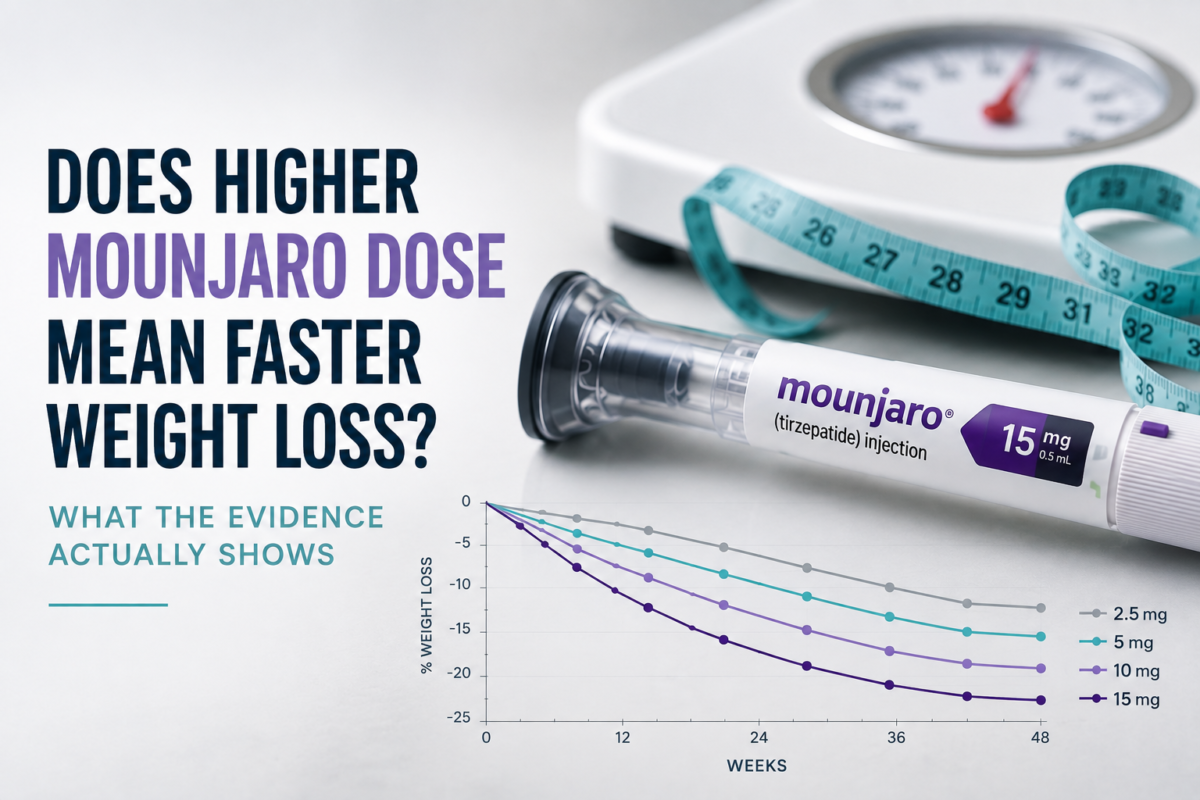
Let’s get the headline fact out first: yes, higher doses of tirzepatide correlate with greater weight loss. A landmark 2023 NEJM study tracking tirzepatide across multiple dose levels found that participants achieved roughly 15% weight loss at the 5mg dose, 19% at 10mg, and 21% at the maximum 15mg dose — when measured over a year with lifestyle support. Sounds significant. But here’s what doesn’t make the headlines: the jump from 5mg to 10mg yielded only 4 percentage points more weight loss, and 10mg to 15mg added just 2 more points.
This is the opposite of what dose-doubling might suggest.
Tirzepatide works through two pathways — GLP-1 and GIP receptor agonism — and the benefit curve flattens considerably past the middle doses. Your body isn’t a linear system. Doubling the dose doesn’t double the effect. It’s more like climbing a hill: those first few steps are steep, but by the time you’re halfway up, you’re working twice as hard for half the elevation gain.
The 2.5mg, 5mg, 10mg progression: why it matters
Evernu — like most UK-licensed weight loss providers — starts patients at 2.5mg precisely because this reflects how the medication titrates in clinical practice. Your body needs time to adapt to the drug’s appetite-suppressing effects. Jump straight to 10mg, and you’re not maximising efficacy; you’re maximising nausea, vomiting, and the risk of dropping out.
A 2024 analysis in the BMJ examined adherence patterns across tirzepatide cohorts and found that patients starting at 2.5mg and titrating slowly had significantly better long-term persistence (staying on the medication) than those fast-tracked to higher doses. Why? Side effects. At 10mg, roughly 40% of early-stage users report moderate-to-severe gastrointestinal symptoms; at 2.5mg, that figure drops to 8%. Tolerability isn’t a cosmetic issue — it’s how people actually lose weight, because they stick with the treatment.
Personalisation Beats Protocol: Why Your Optimal Dose Isn’t Your Neighbour’s
Here’s what generic dosing protocols miss: the same 10mg dose lands differently in a 70kg woman and a 120kg man, in someone with insulin resistance versus someone with a normal metabolic profile, in a patient on three other medications versus one taking nothing else.
Tirzepatide’s metabolism depends partly on body weight, partly on kidney and liver function, and partly on individual genetic variation in drug-metabolising enzymes. An older patient or someone with type 2 diabetes might reach their optimal weight loss at 5mg and see only side-effect escalation beyond that. A younger, metabolically robust person might sail through 5mg and genuinely benefit from pushing to 7.5mg or 10mg.
The NICE guidelines on weight management don’t prescribe a one-size-fits-all dose ceiling because one doesn’t exist. What they do emphasise — and what our experience at Evernu confirms — is individualised titration: start low, increase gradually, monitor response and tolerability, and find the dose that works for that specific person, not the highest available number.
Metabolism trumps ambition
A patient reports back after three weeks at 5mg: appetite is suppressed, energy stable, no nausea. Weight trending down. Is 10mg “better”? Not for that person. Doubling the dose introduces risk — gastrointestinal side effects, potential malabsorption, medication fatigue — in pursuit of a benefit that might not materialise for months, if at all.
Conversely, another patient at 5mg is managing well but plateaus at week 6, despite excellent adherence and lifestyle measures in place. Here, titration to 7.5mg or 10mg makes sense. The difference is informed decision-making between clinician and patient, not assumption.
Unsure what Mounjaro dose is right for you? Our clinicians personalise tirzepatide treatment based on your health profile, not a standard protocol.
Explore personalised weight loss treatment →
Side Effects Scale Faster Than Results: The Hidden Cost of Chasing Higher Doses
Weight loss is only half the equation. You also have to live with the side effects whilst you’re getting there — and that part of the equation gets worse faster than weight loss gets better.
Nausea, the most common tirzepatide side effect, affects roughly 25% of users at 5mg and approximately 35% at 10mg. Not catastrophic, but real. Vomiting (more serious) occurs in about 6% at 5mg and 11% at 10mg. Constipation or loose stools: almost everyone experiences some shift in bowel habit, ranging from manageable to life-disrupting depending on dose and individual physiology.
Then there’s fatigue, which isn’t glamorous enough to make it into the patient information leaflets prominently, yet patients report it constantly. Some tiredness resolves with time; some persists. A patient already managing fatigue due to work or medical conditions might find 10mg genuinely disabling, whilst 5mg produces a gentler, sustainable level of appetite suppression.
The dropout cliff
Real-world data — which matters more than clinical trial data, because trials have exit criteria and patient motivation that real life doesn’t — suggests that roughly 15–20% of people on 10mg tirzepatide stop the medication within six months due to side effects. On 5mg, that figure is closer to 5–8%. The cost of not losing weight because you abandoned the medication is far higher than the modest benefit of an extra few percentage points.
Which brings us to the psychological piece. Patients often feel they’re “not doing it properly” if they’re not on maximum dose. That’s understandable but medically backwards. Your job is to reach a dose that produces results you can tolerate and sustain, not to reach the highest number on the prescription pad.
Tirzepatide Dosage Weight Loss: The Real-World Picture
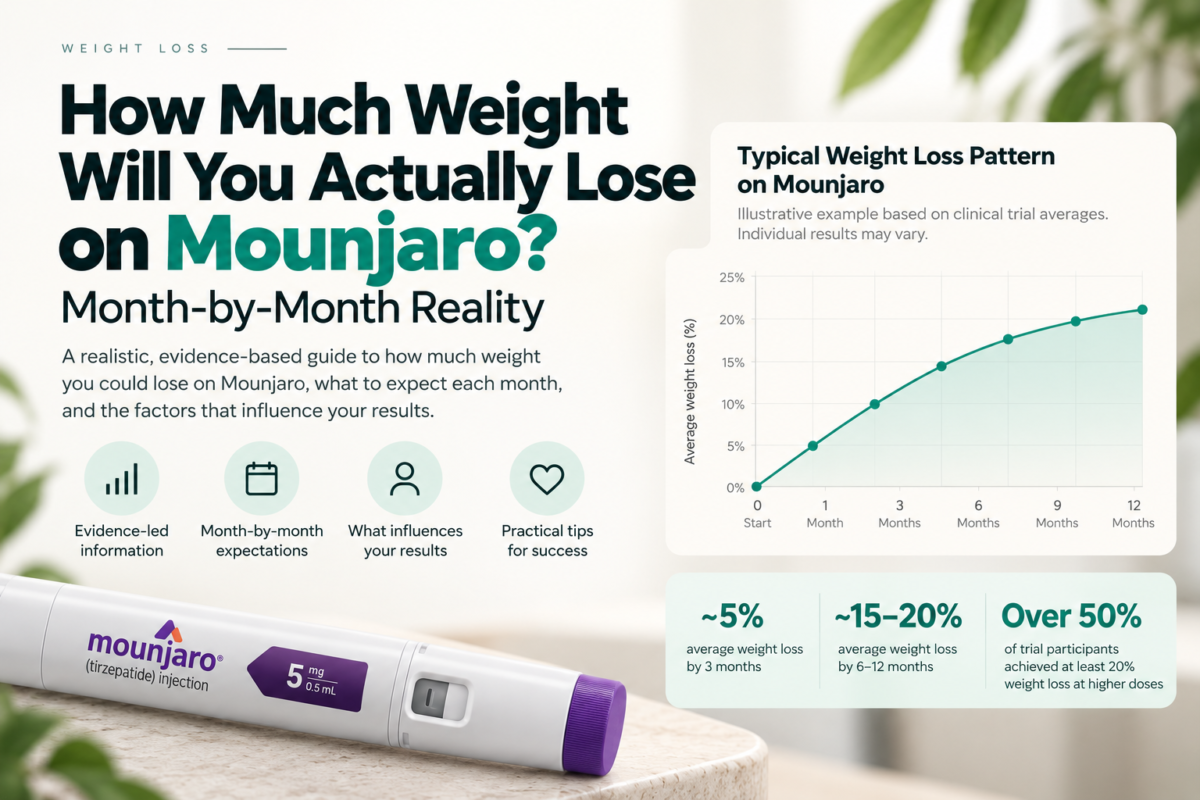
Let’s ground this in what actually happens. A typical patient starting Mounjaro arrives with 20–30kg to lose. After eight weeks at 2.5mg, they’ve dropped 2–3kg, appetite is noticeably suppressed, and they’re adapting to the medication. At week 12, we increase to 5mg. By week 20, they’re 6–8kg lighter. Most people here feel they’ve found their rhythm.
Some patients, at this point, ask: “Why not jump to 10mg and finish faster?” The answer is rarely about what’s theoretically possible; it’s about what’s practically sustainable. An extra 3–4kg over the following months (the realistic difference between 5mg and 10mg) is not worth triggering nausea that disrupts your work, or constipation that becomes a daily management task, or fatigue that erodes your gym motivation.
Others plateau at 5mg after four months. They’ve lost 10kg, but there’s 15kg still to shift and progress has stalled. Here, titration to 7.5mg or 10mg is evidence-based and appropriate. The decision should be made with clinical input, not by default.
What about starting at 5mg instead of 2.5mg?
Some private providers in the UK — not Evernu — do offer fast-track titration: skip 2.5mg, start at 5mg. Is this backed by evidence? Partially. You’ll reach results faster in the first 4–8 weeks. But you’ll also face a higher early dropout rate due to side effects, and long-term outcomes are roughly equivalent. The MHRA-approved product information for Mounjaro recommends starting at 2.5mg precisely to optimise tolerability. Deviating from that shouldn’t be a convenience choice; it should be clinical.
Frequently Asked Questions
Will I lose twice as much weight on 10mg as on 5mg?
No. Based on trial data, you’ll lose roughly 20–25% more weight — so if 5mg produces 15kg loss, 10mg might yield 18–19kg over the same period. That’s meaningful but not linear. Side effects, however, increase more sharply.
How long should I stay on each dose before increasing?
Minimum four weeks at each dose to assess side effects and appetite response. Most clinicians suggest six weeks before deciding to titrate. Rushing past this risks masking early side effects or stopping before giving the current dose a fair chance.
Can I skip 2.5mg and go straight to 5mg?
Yes, some patients do, though it increases early nausea risk. If you’re starting, 2.5mg allows your body to adjust whilst still producing measurable weight loss. If your healthcare provider recommends jumping to 5mg based on your individual circumstances, that’s a different clinical decision — but shouldn’t be default.
Is there a Mounjaro dose that’s “too high”?
The maximum licensed dose is 15mg weekly. Doses above this are off-label and carry unknown risks. Even at 15mg, side effects can be substantial. There’s no clinical evidence that going above the licensed maximum improves long-term outcomes.
What if I’m at 5mg and not losing weight anymore?
Before jumping to 10mg, check three things: adherence (are you taking it perfectly every week?), lifestyle (are diet and movement in line with what worked before?), and timeframe (have you given this dose a full three months?). If all three are solid and you’ve plateaued, titration upward makes sense — but do it under clinical guidance, not assumption.
The evidence is clear: tirzepatide works best when your dose matches your metabolism and your life, not when you’re chasing the highest number available. Higher doses produce more weight loss, but the gains diminish and the costs rise. What matters is finding your personally optimised dose — the one you can sustain, that produces steady results, and that doesn’t hijack your quality of life. That’s not generic protocol. That’s good medicine.