TL;DR
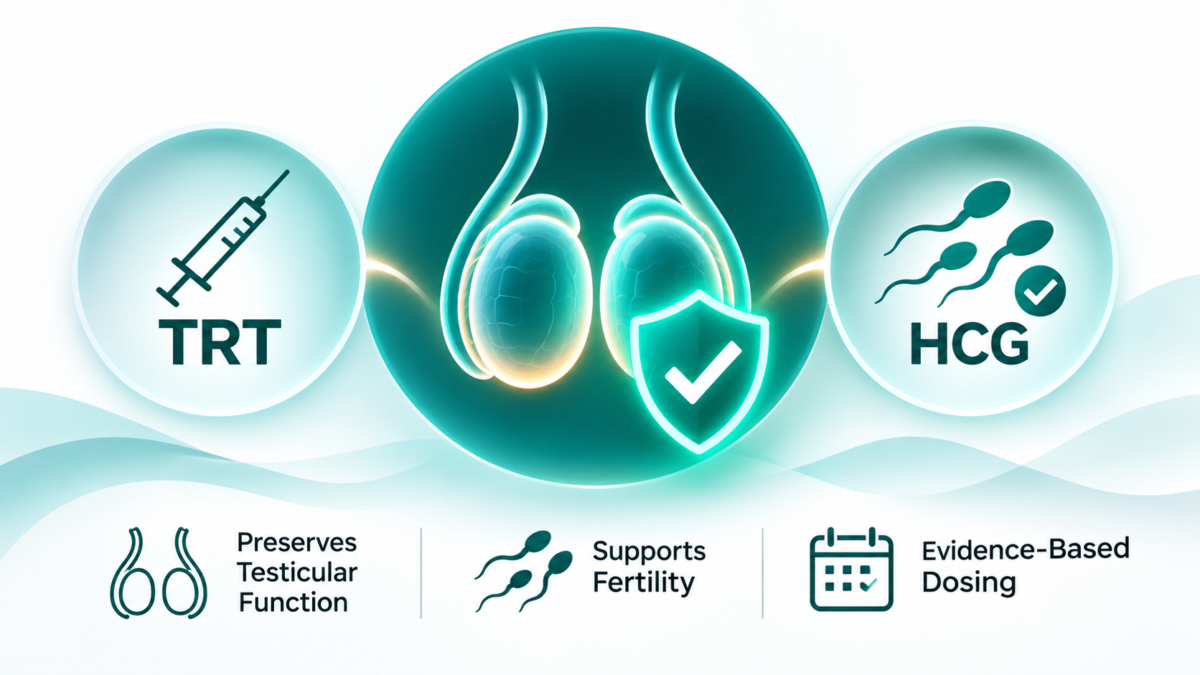
- HCG with TRT stimulates testosterone production within the testes, preventing testicular shrinkage that occurs on testosterone alone.
- UK clinicians typically add HCG when men want to preserve fertility, maintain testicular volume, or keep the testes producing testosterone during treatment.
- Most UK TRT clinics prescribe 750–1,500 IU a week, split across two or three injections. Small studies support low doses like this, though not all men need HCG.
Men starting testosterone replacement therapy face an uncomfortable biological reality: synthetic testosterone tells their pituitary gland to stop producing luteinising hormone (LH), which in turn halts sperm production and shrinks the testicles. It’s not dangerous, but it’s permanent whilst on treatment. Some men don’t mind. Others do—particularly those under 40, those wanting biological children, or those bothered by testicular atrophy. That’s where HCG with TRT enters the conversation.
Human chorionic gonadotropin mimics LH so effectively that it essentially tells the testes, “Keep working.” Add it to testosterone replacement, and you’ve got a protocol that sustains both hormone levels and testicular function. Yet HCG isn’t routine in UK practice. It’s a second-line tool, deployed when the clinical picture demands it. Understanding when—and why—separates thoughtful prescribing from dogma.
How Testosterone Replacement Shuts Down the Testicles
To understand why clinicians add HCG to testosterone replacement, you need to know what testosterone replacement does first.
The pituitary gland monitors circulating testosterone like a thermostat. When external testosterone floods the bloodstream—via injections, gels, or patches—the pituitary reads this and thinks, “We’ve got enough. Stop making LH.” LH normally drives the Leydig cells in the testes to produce testosterone and signals Sertoli cells to maintain sperm production. Kill LH, and both processes flatline.
This suppression happens quickly. Within weeks of starting TRT, sperm counts plummet. Testicular volume shrinks too. These changes usually reverse after stopping treatment, but recovery can take many months and isn’t guaranteed.
But here’s the thing: this doesn’t happen because testosterone replacement is toxic. It happens because the body’s feedback loops are working exactly as evolution designed them.
Enter HCG: Keeping the Testes Online During TRT
HCG replicates what LH does naturally. It binds to the same receptors on Leydig cells and tells them to keep producing testosterone within the testicles themselves. Add it to a testosterone replacement protocol, and you’re essentially running two parallel systems: exogenous testosterone for systemic hormone levels, and HCG to maintain intrinsic testicular function.
The evidence for this approach is promising but limited. In a 2005 study of 29 healthy men on testosterone, testosterone inside the testes fell by 94% without HCG. With 250 IU every other day (about 875 IU a week) it stayed within 7% of its starting level, and with 500 IU every other day (about 1,750 IU a week) it rose by 26%. That study lasted only three weeks. In a 2013 study of 26 men on TRT, 500 IU every other day kept semen results steady over an average of about six months, and no man’s sperm count fell to zero.
HCG is not a guarantee of fertility, though. A December 2025 review notes that US urology guidelines still consider the evidence insufficient to support adding HCG for men who want children more than six months ahead, and it calls for larger, longer studies. If you’re planning a family, raise it with your clinician before you start treatment.
When UK Clinicians Prescribe HCG with Testosterone Replacement
Fertility Preservation and Family Planning
This is the clearest indication. A man aged 28 with low testosterone who wants children in five years? HCG from the start is worth discussing. It can help preserve spermatogenesis and testicular volume, which may keep biological fatherhood an option if he stops treatment or pauses it temporarily.
Some UK clinics—particularly fertility-focused private practices—now recommend HCG routinely for all men under 40 starting TRT. Others reserve it for those who explicitly ask. The NHS, by contrast, rarely prescribes it; budgetary constraints and the fact that most men on TRT aren’t attempting conception means HCG sits outside typical NHS protocols.
Testicular Atrophy Concerns
Atrophy itself isn’t medically dangerous. Shrunken testicles don’t cause pain, erectile dysfunction, or hormonal imbalance (you’re still getting testosterone systemically). But some men find it psychologically distressing—a tangible sign that their body’s natural systems are offline. Others worry about long-term effects we haven’t fully studied yet.
For these men, HCG offers reassurance. It maintains testicular volume and may reduce the psychological burden of treatment.
Keeping the Testes Active During Treatment
Testosterone replacement suppresses the hypothalamic-pituitary-gonadal (HPG) axis. Full suppression. Stop testosterone, and it can take months—sometimes years—for the axis to wake up and resume natural production. This matters for men who might stop TRT in future (due to side effects, lifestyle changes, or simply deciding it’s not for them).
HCG doesn’t stop this suppression: LH and FSH stay low. It works around it by stimulating the testes directly, so they stay active. Some clinicians hope this makes recovery easier if treatment ends, but the evidence is limited.
Considering TRT and want to know if HCG is right for you? Our clinicians assess fertility goals, testicular health, and long-term plans before recommending protocols.
Complete your testosterone assessment →
Standard HCG Dosing and Prescribing Patterns in UK Practice
There’s no universal HCG protocol. In our experience, most UK TRT clinics prescribe 750–1,500 IU a week in total, split across two or three injections. That usually means 250 IU three times a week at the lower end and 500 IU three times a week at the upper end.
Why this range: about 875 IU a week kept testosterone inside the testes close to its starting level in the 2005 study above, and the 2025 review describes a suggested regimen of 1,500 IU once a week for men who aren’t seeking fertility but want to preserve testicular volume. That makes this range a practical sweet spot: enough HCG to keep the testes working, without the extra oestrogen and cost that can come with higher doses. No trial has compared these doses head to head over the long term, so your clinician will adjust the dose to your own results.
If you’re trying for a baby: the 2013 semen results came from about 1,750 IU a week, just above this range, and some clinicians use more for men planning a pregnancy. That’s a separate conversation to have with your clinician, because testosterone itself can stop sperm production.
HCG comes as a powder that’s mixed with liquid and injected under the skin. Men self-inject two or three times a week, often on the same days they inject testosterone. Some clinicians space it differently, but the principle is consistent: keep the Leydig cells stimulated through the week.
Monitoring matters too. Men on HCG + TRT should have oestrogen (E2) checked through blood tests, particularly early in treatment. HCG increases testosterone production in the testes, and some of that converts to oestrogen. Raised oestrogen can cause breast tenderness, water retention and mood changes. If that happens, your clinician may lower the HCG dose or consider an aromatase inhibitor.
Why HCG Isn’t Routine on the NHS
The NHS prescribes testosterone replacement. HCG, as an add-on therapy, sits outside most NHS TRT protocols. There are reasons for this, some practical, some ideological.
Cost is one. HCG adds to the cost of treatment, and NHS budgets don’t stretch to routine off-licence prescribing when the primary condition (hypogonadism) is adequately treated with testosterone alone. The NHS also takes a pragmatic view: most men on TRT aren’t attempting conception, so fertility preservation isn’t a priority.
Clinical guidelines don’t mandate it either. No NICE guideline recommends HCG alongside TRT, so NHS endocrinologists and GPs have no formal recommendation to prescribe it. Private clinics, unburdened by these constraints, are more likely to offer it as part of a comprehensive protocol.
This creates a two-tier system. Private practitioners can tailor TRT to individual goals—fertility, testicular volume, axis recovery. NHS patients get effective testosterone replacement, but without the option to add HCG for preservation of testicular function.
Side Effects and Monitoring When Using HCG with TRT
HCG is generally well tolerated. It’s a naturally occurring hormone, extracted from the urine of pregnant women or produced via cell culture. But it’s not free of side effects, particularly when combined with testosterone.
Oestrogen elevation: The most common issue, and more likely at higher doses. HCG stimulates intratesticular testosterone production, which converts to oestrogen. Men may develop breast tenderness, emotional sensitivity, or water retention. Your clinician may lower the HCG dose or add an aromatase inhibitor.
Polycythaemia: Both testosterone and HCG can raise haematocrit (red blood cell count). This thickens blood and increases thrombotic risk—clots, stroke, MI. Regular full blood counts (every six months initially, then annually) catch this early. Some men need phlebotomy (venesection) if haematocrit climbs above 54 percent.
Acne and mood changes: Dose-dependent, rare at standard HCG doses, but worth monitoring.
The strongest argument against HCG isn’t safety—it’s that most men don’t need it. Fertility preservation matters to a minority. Testicular volume concerns are psychological, not medical. For men on TRT who simply want testosterone levels restored, HCG adds cost and monitoring complexity without clear benefit.
Frequently Asked Questions
Does HCG prevent testicular atrophy completely?
Not completely. At the usual 750–1,500 IU a week, HCG helps maintain testicular volume, but some men still lose a little. Higher HCG doses may do more, but they can also raise oestrogen and polycythaemia risk.
Can I take HCG if I’m not interested in fertility?
Yes. Some men use HCG purely to maintain testicular function and the psychological comfort that comes with it. There’s no medical reason to preserve testicular size if you don’t want children, but if atrophy bothers you, HCG addresses it.
How quickly does testicular function return after stopping HCG?
If you stop HCG but continue testosterone, testicular function suppresses within weeks—the same as if you’d never used HCG. If you stop both testosterone and HCG, recovery often takes many months, and sperm production can take a year or longer to return fully. It isn’t guaranteed, so talk to your clinician before stopping if you’re planning a family.
Is HCG available on the NHS?
Rarely. It’s licensed and available (human chorionic gonadotropin is MHRA-approved), but NHS protocols don’t routinely include it for testosterone replacement. Private clinics prescribe it frequently for men with fertility concerns or testicular preservation goals.
Do I need an aromatase inhibitor with HCG?
Not everyone does. HCG can raise oestrogen, more so at higher doses, so your clinician should check your baseline E2 and recheck it after 6–8 weeks of HCG. If your levels are high or you have symptoms, they may lower the HCG dose or add an aromatase inhibitor.
The Practical Reality of HCG and Testosterone Replacement
HCG with TRT isn’t a universal answer—it’s a tool deployed when the clinical picture justifies it. For men who want to help preserve fertility or maintain testicular volume, it can work. Small studies support low doses of around 750–1,500 IU a week, and side effects are manageable with monitoring.
But it’s not mandatory, not routine, and not right for everyone. A 55-year-old man with no fertility concerns, satisfied with testosterone alone, has no reason to add HCG. A 32-year-old wanting biological children in five years? That’s a genuine case for combined therapy.
The key is matching protocol to individual goals. If you’re considering testosterone replacement therapy, have an explicit conversation with your clinician about fertility, testicular preservation, and what matters to you long-term. That dialogue—not a standard protocol—should determine whether HCG is part of your treatment plan.