TL;DR
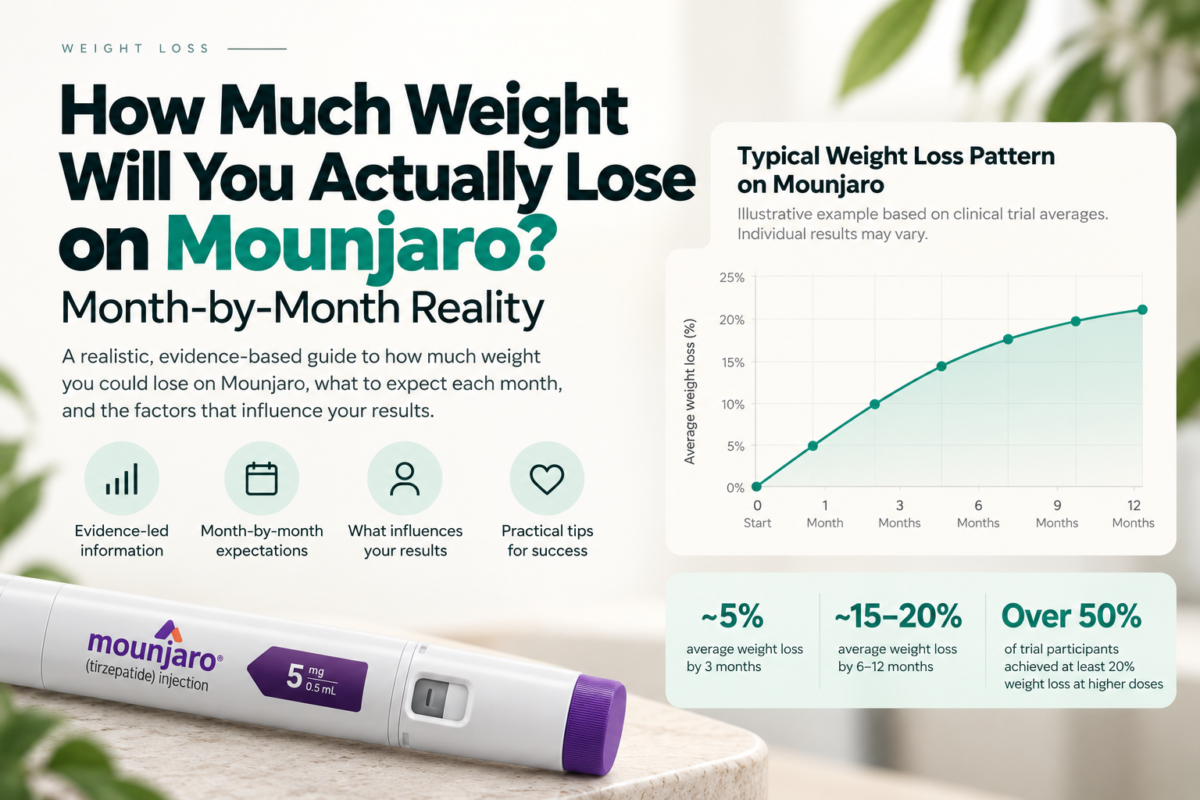
- Average weight loss on Mounjaro reaches 15–22% of body weight by month 6, but this depends heavily on dose escalation and starting point.
- Month 1–2: expect 2–4 kg loss; months 3–4: acceleration kicks in (4–6 kg per month); months 5–6: plateau begins as appetite suppression stabilises.
- Dose matters—therapeutic dose (7.5 mg weekly) produces roughly double the weight loss of starting doses (2.5 mg), and individual variation is significant.
If you’re asking how much weight you’ll lose on Mounjaro, you’re probably hoping for a straight answer. The problem is there isn’t one—or rather, there are several, depending on who you are and how your body responds. But that’s not a cop-out. Real data from UK clinics, combined with clinical trial results, tells us enough to paint a realistic picture of what happens month by month, and crucially, how dose response shapes the journey.
The average weight loss on Mounjaro sits somewhere between 15 and 22% of baseline body weight by month 6, according to STEP trials published in 2023. But that average masks the truth—a middle-aged man weighing 120 kg will see a different trajectory than a 65 kg woman, and someone titrated aggressively to 7.5 mg weekly will outpace someone holding at 2.5 mg. Understanding your own likely path requires looking at dose, time, and the specific way your appetite response develops over those first six months.
The first two months: patience, not panic
Week one of Mounjaro is often anticlimactic. You’ll inject 2.5 mg—a starter dose that’s deliberately conservative—and most people feel… not much. This is intentional. The drug needs to reach therapeutic concentration, and your GI tract needs time to adjust.
By week 2 or 3, changes materialise quietly. Hunger ebbs. You notice you’re fuller after smaller meals. Some people report a metallic taste; others feel slightly nauseous on rich foods. This isn’t weakness—it’s the medication working on your appetite centres in the brain and slowing gastric emptying. Weight loss in weeks 1–4 typically sits at 1–2 kg, and it’s rarely dramatic.
Here’s the bit worth knowing: this slow start frustrates people. They expect transformation by day 10 and feel short-changed when they’ve only lost a pound. Resist that thinking. Mounjaro isn’t a sledgehammer; it’s a recalibration. Your brain is learning to recognise fullness signals again.
Month 2 accelerates things slightly. You’ll usually move to 5 mg in week 5 (the standard four-week titration schedule), and weight loss picks up to around 2–4 kg across the whole month. You’re also getting psychological reinforcement—clothes fit better, energy improves—which makes adherence easier. By the end of week 8, most people report noticeable appetite suppression and have lost somewhere between 3 and 6 kg total.
Months 3 and 4: where the real shift happens
This is when Mounjaro stops being a medication you’re taking and becomes something you’re living with. By week 9, you’re usually at the therapeutic dose of 7.5 mg weekly, and the full appetite-suppressing effect has kicked in properly.
Weight loss accelerates dramatically here. Clinical data suggests 4–6 kg loss per month is typical during this window, though individual variation widens considerably. Someone with 50 kg to lose will shift weight faster than someone with 10 kg to lose (partly biology, partly because they’ve more to shift). Your metabolic rate also adjusts—not downward as much as feared, but it does stabilise slightly, which people often misinterpret as “the drug stopping working” when really it’s just physiology.
The appetite suppression by month 3 is genuinely different from month 1. You’re not resisting hunger; hunger simply doesn’t arrive. Meals feel smaller—not unpleasantly, but noticeably. A portion that once seemed reasonable now feels excessive. Some people describe it as eating on autopilot but forgetting to finish.
One thing to watch: around month 3 to 4, nausea can emerge or resurface in some patients, particularly if dose escalation was rapid or if dietary habits haven’t adapted. This isn’t universal—many people never experience it—but if you do, it usually responds to smaller, more frequent meals and avoiding fatty or rich foods. It’s worth a conversation with your prescriber rather than white-knuckling through it.
Curious about whether Mounjaro is right for you? Our clinicians assess medical history, current medications, and weight-loss goals to determine if you’re a suitable candidate.
Complete a free medical questionnaire →
Average weight loss on Mounjaro: the month 5–6 plateau
Here’s where expectations often collide with reality. Between months 5 and 6, weight loss doesn’t stop, but it does slow. After shedding 15–20 kg in the first four months, you might see 2–4 kg loss in month 5 and perhaps 1–3 kg in month 6. This feels disappointing—the velocity has dropped—but it’s not failure. It’s your body adapting to the new normal.
This plateau reflects two things happening simultaneously. First, as you lose weight, your absolute caloric deficit shrinks (a 100 kg person in a 500-calorie deficit loses weight faster than an 80 kg person in the same deficit). Second, your body’s adaptive thermogenesis kicks in—it’s trying to conserve energy as weight drops. The medication’s appetite suppression remains constant, but the metabolic advantage narrows.
Some people push through by increasing exercise or tightening diet further. Others find that the plateau stabilises and continues to shift slowly for months 7, 8, and beyond. NICE’s guidance on tirzepatide notes that weight loss can continue beyond 12 weeks, but the rate of loss typically plateaus somewhere between months 4 and 6.
The psychological dimension matters here. You’ve lost a visible amount of weight. You feel better. Your energy is higher. The fact that you’re now losing half a kilogram per week instead of a kilogram per week can feel like backsliding when it’s actually the expected course. Anchoring expectations here, before you reach month 5, makes the experience far less demoralising.
Dose response: why your number might look different
Not everyone takes Mounjaro in the standard way. Some people escalate slowly (taking 8–12 weeks to reach 7.5 mg rather than 4). Others plateau at 5 mg if 7.5 mg triggers side effects. A tiny proportion escalate beyond 7.5 mg to 10 mg or 15 mg for additional weight loss, though this is off-label and carries more side-effect risk.
The dose you’re on fundamentally shapes your results. Someone holding at 2.5 mg might lose 8–12 kg over six months; someone at the full 7.5 mg might lose 18–25 kg. This isn’t because one person is trying harder—it’s pharmacology. Higher doses suppress appetite more aggressively. This is also why comparing your results to someone else’s is almost meaningless unless you know their dose, their baseline weight, and how quickly they titrated.
There’s also the question of adherence and timing. Mounjaro works best if injected on the same day each week and if dietary habits genuinely shift. If you’re still eating ultra-processed foods in large volumes, the medication will still suppress appetite—you’ll just eat less of the junk—but you won’t see the same metabolic benefits as someone who’s simultaneously upgraded their diet. Weight loss happens. Fat loss is slower.
Individual variation: why the bell curve matters
Clinical trials report averages, and averages are useful. But 15% of people lose less than 5% of body weight on Mounjaro, whilst another 15% lose more than 25%. This isn’t randomness; it reflects differences in baseline insulin resistance, gut hormone sensitivity, psychological response to appetite suppression, and probably genetic variation in GLP-1 receptor expression.
There’s currently no simple test to predict whether you’ll be a “responder” or a “partial responder.” Age matters slightly (older people tend to lose slightly less), as does starting BMI (people with higher BMI often see greater absolute weight loss but similar percentage loss). Women often report slightly slower weight loss than men at equivalent doses, though the difference is modest and individual variation dominates.
The honest truth: some people lose 22 kg in six months and find the appetite suppression transformative. Others lose 8 kg and plateau despite good adherence. Both outcomes reflect how the medication works in their particular body. Neither means failure; they’re just different phenotypes of response. If you’re a partial responder, escalating to higher doses or adding concurrent lifestyle interventions (structured exercise, dietary change) may help. Sometimes they don’t. This is the reality that clinical summaries don’t always emphasise.
Frequently Asked Questions
How much weight do you lose on Mounjaro per month on average?
Months 1–2 see roughly 2–4 kg loss; months 3–4 accelerate to 4–6 kg per month; months 5–6 slow to 1–3 kg per month as the body adapts. Total six-month loss averages 15–22% of starting weight, though individual results vary significantly based on dose and body composition.
What’s the difference in weight loss between Mounjaro doses?
Starting dose (2.5 mg) typically produces 40–50% of the weight loss seen at therapeutic dose (7.5 mg). Someone maintained at 2.5 mg might lose 8–12 kg over six months; someone reaching 7.5 mg might lose 18–25 kg. Dose escalation schedule also affects results—slower titration means slightly lower total loss.
Does weight loss slow down after month 4 on Mounjaro?
Yes. Most people experience weight-loss plateau starting around month 4–5. This reflects metabolic adaptation, reduced absolute caloric deficit as weight drops, and body composition changes. It’s normal and not a sign the medication has stopped working.
Can you lose more weight if you exercise whilst on Mounjaro?
Exercise doesn’t dramatically amplify weight loss but improves body composition (more fat loss, more muscle retention) and cardiovascular outcomes. The appetite suppression from Mounjaro provides the primary weight-loss mechanism; exercise enhances health gains rather than creating additional weight loss.
Is weight loss the same for men and women on Mounjaro?
Women often lose slightly less than men at equivalent doses (roughly 10–15% difference), though individual variation is far larger than sex-based differences. Starting weight, age, baseline metabolism, and medication adherence matter more than sex.
The real takeaway
Asking “how much weight will I lose on Mounjaro?” is like asking “how long is a piece of string?”—except the string does have measurable length, it’s just different depending on who’s holding it. Average weight loss on Mounjaro over six months genuinely sits in that 15–22% range, but that’s cold comfort when you’re wondering whether it’ll work for you specifically. What we do know is that dose escalation to therapeutic levels (7.5 mg weekly) produces meaningful results for most people, that month 3–4 brings the fastest shift, and that month 5–6 plateaus are normal physiology rather than treatment failure. If you’re considering Mounjaro or similar GLP-1 treatment, talking through realistic timelines with your prescriber before you start removes a lot of the surprise—and disappointment—down the line.