TL;DR
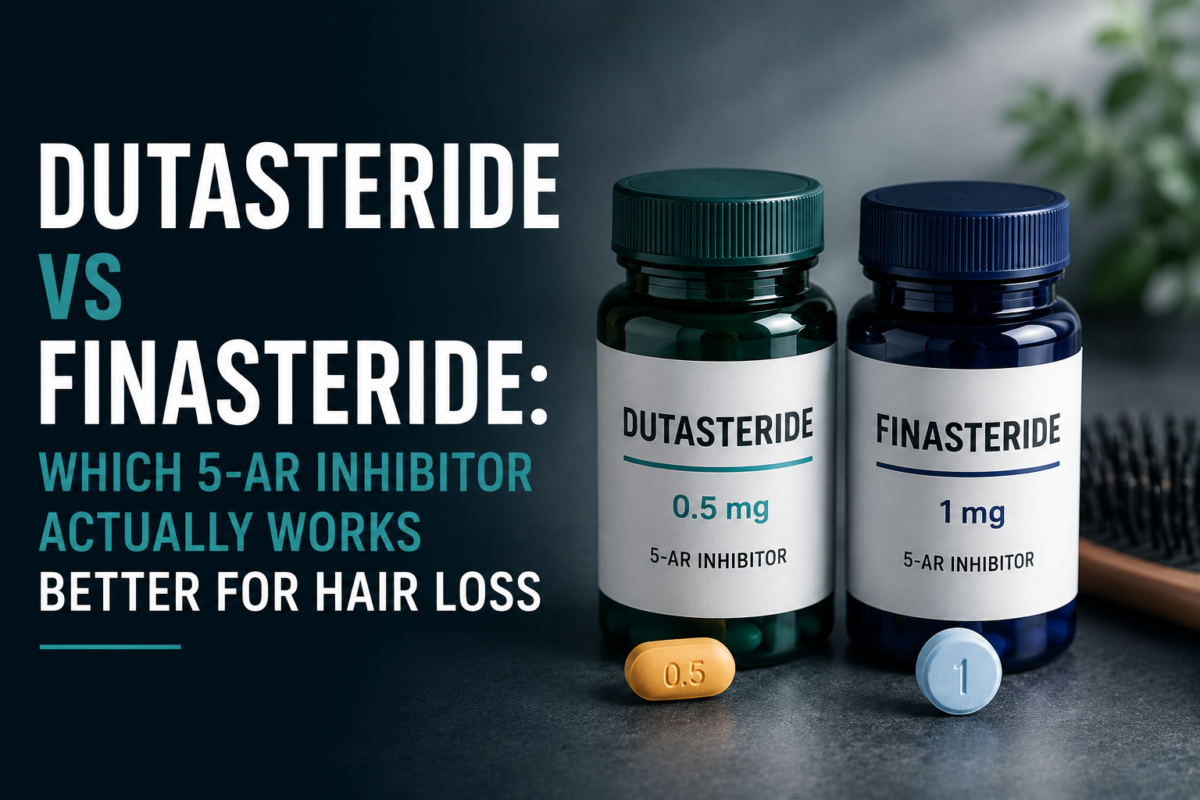
- Dutasteride blocks more DHT than finasteride and shows superior regrowth in head-to-head trials, but the difference is modest—roughly 10–15% more hair at 12 months.
- Finasteride remains first-line because it’s cheaper, requires less frequent dosing (1mg daily vs 0.5mg daily), and carries an identical side-effect profile; most men see meaningful results.
- Switch to dutasteride if you’ve plateaued on finasteride after 12+ months, or consider it from the start if you want maximum efficacy and cost isn’t a barrier.
Somewhere between month three and month twelve on finasteride, a peculiar thing happens to men with male pattern baldness: the initial panic subsides, regrowth arrives, and they stop obsessively photographing their hairline under different lighting. Then, around month 18, some of them plateau. The hair stabilises. Regrowth stalls. And they wonder: is there something stronger?
Enter dutasteride—the more potent cousin in the 5-alpha reductase inhibitor family. The question of dutasteride vs finasteride has spawned countless Reddit threads, contradictory anecdotes, and genuine clinical confusion. This comparison exists partly because pharmaceutical trials favour the agent under investigation, partly because switching between the two carries real risks if done carelessly, and partly because the absolute difference in outcomes is smaller than marketing suggests. What you actually need to know is straightforward: which drug matches your circumstances, your tolerance for risk, and your expectations.
How These Drugs Actually Work—And Why It Matters
Both medications belong to the same class: they inhibit 5-alpha reductase, the enzyme that converts testosterone into dihydrotestosterone (DHT). DHT is what drives pattern baldness in genetically susceptible men. Block DHT, stabilise hair, grow some back. Simple enough on paper.
The mechanical difference is where things get interesting. Finasteride inhibits primarily Type II 5-alpha reductase, found mainly in the scalp and prostate. Dutasteride inhibits both Type I and Type II. This dual action means dutasteride suppresses DHT more aggressively—studies show it reduces serum DHT by roughly 90% compared to finasteride’s 70%. Sounds compelling. The catch? That extra 20% suppression doesn’t necessarily translate to 20% more hair, because you’ve already crossed the threshold where DHT inhibition becomes effective for most men.
Think of it like this: the first 50% reduction in DHT produces the majority of benefit; the next 40% produces noticeable benefit; the final 10% produces marginal gains in a subset of responders. Dutasteride operates further along that curve.
Efficacy: What the Trials Actually Show
The evidence is reasonably robust, though not without limitations. A landmark 2002 study published in the Journal of the American Academy of Dermatology compared the two drugs head-to-head over two years. Dutasteride produced approximately 10–15% more hair count at 12 months than finasteride at equivalent doses, and that advantage persisted through month 24.
That’s measurable. It’s not trivial. But it’s not transformative either.
Finasteride trials showed roughly 66% of men experienced some hair regrowth by 12 months; approximately 40% saw moderate to dense regrowth. Dutasteride nudges those figures upward—perhaps to 75% and 50% respectively—but you’re not talking about wholesale reversal of baldness. You’re talking about meaningful stabilisation plus modest cosmetic improvement in a larger proportion of men.
The critical context: neither drug regrows hair in men with advanced alopecia (Norwood Stage VI or VII). Both work best when you intervene early, whilst you still have enough follicles to rescue. Delayed treatment—say, waiting five years before starting—neutralises much of the superiority dutasteride might otherwise offer.
Side Effects: The Profile Is Identical, But Reporting Isn’t
Here’s where folklore collides with pharmacology. You’ll read claims online that dutasteride causes more sexual dysfunction, more gynecomastia, more depression. The clinical reality is different. Controlled trials show adverse event rates are indistinguishable between the two drugs. Sexual dysfunction occurs in roughly 1–2% of men on either agent in placebo-controlled trials (though observational data suggests real-world rates may be somewhat higher for both). Gynecomastia is rare with both.
Why the perception of difference? Dutasteride carries a longer half-life—approximately 5 weeks versus finasteride’s 6–8 hours. If side effects emerge, they persist longer. Switching from finasteride to dutasteride might unmask intolerance through sheer duration of exposure. And men who’ve already tolerated finasteride for months sometimes develop new symptoms on dutasteride, not because the drug is inherently worse, but because prolonged DHT suppression itself—rather than the drug—can trigger changes in mood or libido.
The NHS recognises both as first-line treatments for male pattern baldness precisely because efficacy and tolerability are comparable. The choice between them is seldom driven by safety alone.
Cost and Practicality: Why Finasteride Remains Default
Dutasteride is typically more expensive. Generic finasteride—the 1mg formulation—costs roughly £10–20 per month on the NHS or privately. Dutasteride ranges from £30–60 monthly depending on supply and licence status. Over five years, that’s a difference of £1,200–2,400, which matters to most people.
Dosing also differs. Finasteride requires daily administration (1mg). Dutasteride is taken every other day (0.5mg), which some men find more convenient and others find unnecessarily fiddly. Neither is onerous, but finasteride’s once-daily regime aligns better with existing medication habits for most men.
There’s also a regulatory nuance worth knowing: finasteride is MHRA-licensed for male pattern baldness under the brand names Propecia (prescription) and Fincar (generic). Dutasteride carries an MHRA licence for benign prostatic hyperplasia under the brand Avodart, but its use for hair loss remains off-label in the UK—though clinically accepted and widely prescribed by specialists. This distinction matters for insurance coverage and, arguably, for medicolegal protection should complications arise.
Uncertain whether finasteride or dutasteride is right for you? Our clinicians can review your hair-loss history, current medications, and preferences to recommend the most appropriate 5-AR inhibitor.
Start your free assessment →
When to Switch From Finasteride to Dutasteride
The decision to switch is underappreciated. Many men stay on finasteride indefinitely, even if results plateau, simply because “it’s working” (meaning it’s holding what they have). Switching carries risks—particularly the risk of temporary shedding as the follicle cycle resets—so it’s worth doing deliberately, not impulsively.
The Right Timing
You’ve given finasteride an honest trial: at least 12 months of consistent use at the correct dose (1mg daily). Your hair has stabilised, but regrowth has stalled. You’re not experiencing intolerable side effects. You want to maximise remaining follicle potential. These conditions suggest switching might yield results. The absolute benefit is uncertain—perhaps 5–10% additional improvement—but in the context of advanced alopecia where every follicle counts, that can matter psychologically and cosmetically.
Conversely, if you’re only six months in on finasteride, switching is premature. Regrowth on these drugs is glacially slow; the dense terminal hairs that appear at month 12–18 haven’t fully mineralised by month six.
The Wrong Reasons to Switch
Starting dutasteride because finasteride “isn’t working” within three months is misguided. Neither drug works that quickly. Switching because you’ve read that dutasteride is “stronger”? It is, marginally—but not by enough to justify the cost difference if you’re already stable on finasteride. Switching because you’re experiencing sexual side effects on finasteride? You’ll likely experience them on dutasteride too, and you’ve now extended the duration of DHT suppression, which may worsen matters.
Starting Dutasteride de Novo: The Case For and Against
Some men—and some clinicians—argue for beginning with dutasteride rather than finasteride, betting that superior suppression of DHT yields better long-term outcomes and fewer men needing to switch later. The logic is sound, even if the evidence is mixed.
The counterargument is practical: finasteride’s lower cost, simpler dosing, and identical side-effect profile make it the rational first-line choice for population-level baldness management. Dutasteride enters the picture when that first line has done what it can, or when a patient explicitly prioritises maximum regrowth over cost considerations. In the NHS context, this distinction is especially important because resources follow guidelines, and first-line treatment protocols matter for equity.
That said, a man in his 30s with advanced alopecia, a family history of aggressive hair loss, and adequate funds might reasonably choose dutasteride from day one, accepting the cost in exchange for a statistically superior probability of meaningful regrowth. There’s no clinical reason to deny him that choice—only an economic one.
Switching Back: An Overlooked Option
Some men tolerate finasteride beautifully for years, then experiment with dutasteride and discover the longer half-life brings unwanted effects—usually mood shifts or sexual changes that are subtle enough not to appear in trials but substantial enough in individual experience. Switching back to finasteride is entirely reasonable and carries no penalty. The quicker washout (6–8 hours) may actually offer relief within days, whereas dutasteride’s 5-week half-life means suffering through a longer transition.
Frequently Asked Questions
Can you take dutasteride and finasteride together?
No. There’s no additive benefit—you’re redundantly inhibiting the same enzyme via two routes—and it increases the risk of adverse effects without improving outcomes. If you’re switching, stop one, wait a week, then start the other.
How long does it take to see results with dutasteride?
Similar timeline to finasteride: stabilisation within 3–6 months, noticeable regrowth by 12 months, maximum benefit by 18–24 months. The extra potency doesn’t accelerate the visual result; it increases the probability and density of regrowth, which takes months to manifest.
Will stopping either drug cause rapid hair loss?
Yes. DHT quickly rebounds (within weeks for finasteride, over months for dutasteride due to its long half-life), and any hair maintained or regrown by the drug will shed. This isn’t worsened hair loss—it’s loss of the drug’s effect. Most men return to their pre-treatment trajectory within 6–12 months. The takeaway: these are maintenance therapies, not cures.
Is dutasteride safer for the prostate than finasteride?
Dutasteride suppresses DHT more thoroughly, which theoretically offers greater prostate protection in men with benign prostatic hyperplasia. For men using these drugs solely for baldness, the prostate question is largely academic. Both reduce prostate cancer risk slightly, though the absolute number of cancers prevented per 1,000 men treated is tiny.
What’s the evidence for combining 5-AR inhibitors with minoxidil?
Clinical trials show additive benefit when minoxidil is layered over finasteride or dutasteride—the two drugs work via different mechanisms, so they complement one another. Many specialists recommend this combination for men seeking maximum regrowth, especially in earlier stages of alopecia where follicle density still permits meaningful cosmetic gain.
The Bottom Line
Dutasteride is the more potent drug. It produces superior hair counts in comparative trials and appeals to men who want to leave no stone unturned in fighting baldness. But finasteride remains the rational starting point for most men: it’s cheaper, equally safe, easier to take, and solves the problem for the majority of those who use it correctly and patiently. The choice between them hinges on whether you’re optimising for cost and simplicity (finasteride) or willing to spend more for a modest increase in the probability of better regrowth (dutasteride). Neither is objectively “better”—only better suited to different priorities. Start with finasteride unless there’s a specific reason not to. If you plateau after 12 months and want to pursue every option, switching to dutasteride is evidence-supported. And if dutasteride doesn’t suit you, finasteride remains a perfectly effective fallback.