TL;DR
- Appetite suppression starts within days, but peaks around week 2–3 after your first injection.
- Measurable weight loss typically begins in week 3–4, accelerating after the first month.
- GI side effects (nausea, constipation) often arrive before the weight loss kicks in—they usually settle by week 4–6.
- Full therapeutic effect requires 16–20 weeks on a stable dose; expecting results before then sets you up for disappointment.
Here’s what nobody tells you about Mounjaro: the drug works brilliantly, but not on your timeline. Patients ring us up at week two convinced something’s gone wrong because they haven’t shed a stone yet. They’ve missed the bit where appetite changes precede weight loss by weeks. Understanding the actual sequence of events—when satiety kicks in, when your gut adjusts, when the scales finally move—is the difference between frustration and realistic expectation.
So how long does Mounjaro take to work? The honest answer: it depends what “work” means to you. Appetite suppression? Days to a week. Measurable weight loss? Three to four weeks. Optimal results? Sixteen weeks minimum. This timeline matters because GLP-1 treatment is genuinely effective, but only if you stick with it long enough to reach the plateau.
Week 1: The Injection and the Wait
You get your first 0.25 mg dose. Nothing dramatic happens on day one. No sudden transformation, no miraculous appetite vanishing. This is where many people get impatient—or worse, assume the injection was a dud.
What’s actually occurring beneath the surface is your body recognising tirzepatide (Mounjaro’s active ingredient) for the first time. The drug targets two hormone pathways: GLP-1 receptors, which regulate appetite and blood sugar, and GIP receptors, which influence satiety and energy use. Activating both simultaneously is what separates tirzepatide from older semaglutide treatments—but that dual action takes time to build.
By day 3–5, some people notice the earliest sign: a subtle shift in how food appeals to them. Not hunger vanishing entirely. More like the volume dial on appetite gets turned down. You might push a plate away half-full and think, “When did I start leaving food?” Others notice nothing at all. Both are normal.
Nausea might appear this week—it affects roughly 15% of patients in the first fortnight. It’s usually mild (a slight queasiness rather than actual vomiting), and here’s the thing: it often correlates with better weight loss outcomes later, possibly because people naturally eat less when their gut’s making its feelings known. That said, it’s unpleasant, and nobody should pretend otherwise.
Weeks 2–3: When Mounjaro Starts to Feel Real
This is when most people notice genuine appetite suppression. Hunger cues flatten. Portion control becomes almost automatic—you’re full on half what you’d normally eat, and you’re not fighting it.
The mechanism here is worth understanding: tirzepatide slows gastric emptying (the rate your stomach pushes food into your intestines) and triggers satiety signals in the brain’s hypothalamus. You’re not white-knuckling through hunger; the biological signal to keep eating has dimmed. Clinical trials show this effect appears within the first two weeks for most patients, though the magnitude varies.
Food preferences sometimes shift too. Fatty or heavily sweetened foods become less appealing—your brain no longer rewards you as intensely for eating them. Some people describe it as newfound indifference to previously favourite foods. Others notice they can’t manage large meals without feeling uncomfortable. This isn’t willpower winning. It’s pharmacology.
On the flip side, GI side effects often peak now. Nausea, constipation, and loose stools are the trinity—not everyone gets all three, but many get at least one. Constipation is particularly common because slowed gastric motility also means slowed intestinal transit. The good news: these effects are transient. Eating smaller, more frequent meals and staying hydrated (genuinely, not performatively) reduces the impact by week 4–5 for most people.
Weeks 4–8: The Weight Starts Moving
This is when you’ll see the scales respond. Weight loss typically begins in earnest by week 3–4, accelerating through weeks 4–8. Patients report losing 2–4 kg in the first month once they hit a stable dose.
Why the lag between appetite suppression and weight loss? Because appetite change alone doesn’t instantly translate to pounds shifted. Your body’s still adjusting to eating less; your metabolism hasn’t fully recalibrated yet. Water retention can mask early fat loss (many people actually retain fluid initially due to reduced sodium intake and constipation). And you’re still on the starting dose—0.25 mg—which is deliberately conservative.
After week 4, your dose escalates to 0.5 mg (this is the standard titration schedule for most UK patients). This is your first real dose increase, and it often produces another small bump in appetite suppression and, subsequently, another dip on the scales within days.
By week 8, GI side effects have usually settled considerably. Your gut’s adapted. People tolerate larger doses without the nausea and cramping that characterised week 2–3. You’re also becoming behaviourally accustomed to smaller portions—it stops feeling like deprivation and starts feeling normal.
Weeks 9–20: Building Momentum Toward Optimal Effect
This is the grind phase—less dramatic than the first month, but critically important. Doses continue escalating: 0.75 mg at week 8, 1.0 mg at week 12, and potentially up to 2.4 mg depending on your response and tolerance.
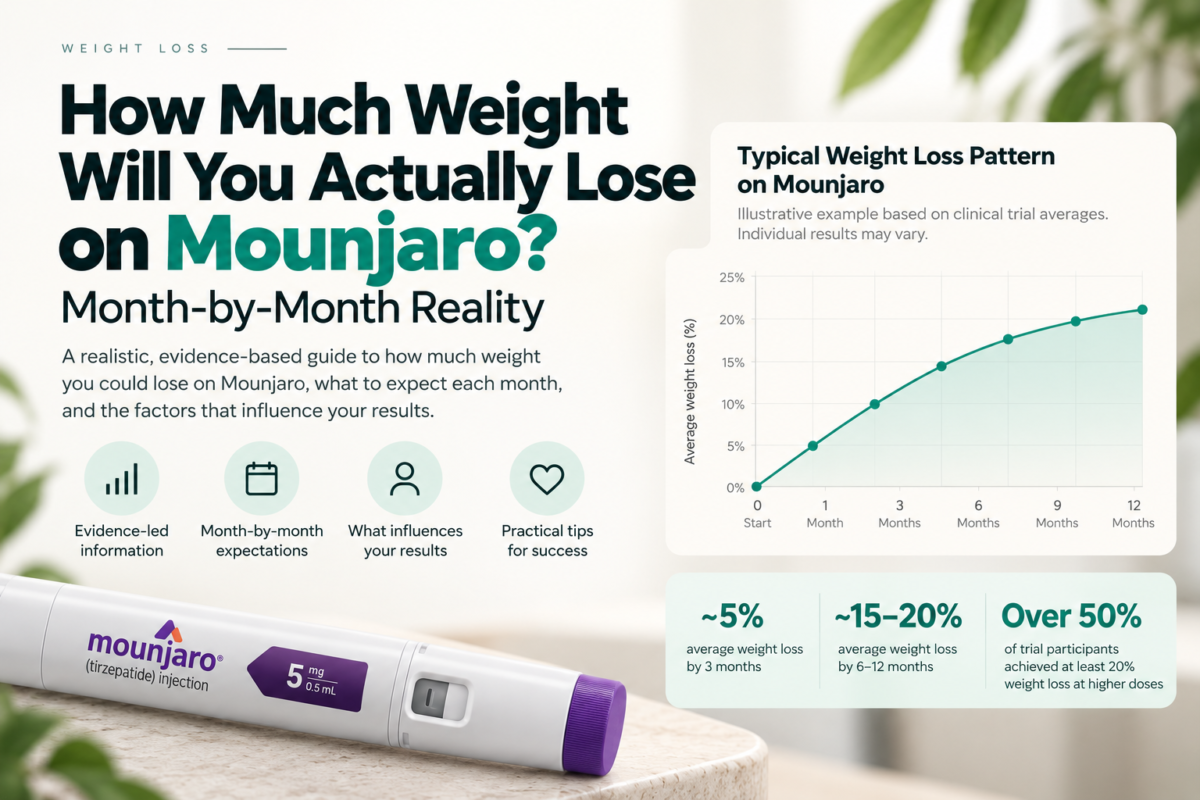
Weight loss accelerates as you reach higher doses. Patients on 2.0–2.4 mg typically lose 15–22% of their body weight over a full treatment cycle—but only if they’ve given the drug time to reach that dose without skipping weeks or pausing the escalation.
Here’s where patience becomes clinical strategy. Rushing dosing schedules because you want faster results backfires: you’ll experience worse side effects, higher dropout rates, and paradoxically slower overall weight loss because you’ll have stopped taking it. The titration exists because it works.
By week 16–20, most people reach their therapeutic “sweet spot”—the dose where appetite suppression is stable, side effects are minimal, and weight loss has plateau’d at a predictable rate. This is also why NICE guidance and most UK weight loss clinics insist on a minimum 16-week assessment period before evaluating whether Mounjaro’s genuinely working for you.
Want to know if Mounjaro’s right for you? Our specialists assess your medical history, timeline, and goals before recommending treatment.
Complete your weight loss questionnaire →
Beyond 20 Weeks: Plateau and Stability
After five months, weight loss often slows naturally. This isn’t failure—it’s your body reaching a new equilibrium at a lower weight. Metabolism adapts; hunger hormones slowly creep back up as your body defends its new “set point.” Total weight loss typically plateaus between months 6–12.
Some people continue losing weight steadily for a full year; others plateau at month 4. Both patterns are described in published trials and both are considered normal. The variability depends on baseline metabolism, adherence, diet quality, and exercise—Mounjaro amplifies the effects of good behaviour, it doesn’t replace them entirely.
Importantly, NICE recommends reassessing weight loss progress at six months. If you’ve lost less than 5% of your body weight by then—assuming you’re on a stable, therapeutic dose and tolerating it well—your clinician might explore alternative approaches or diagnose secondary factors limiting response.
What to Expect in the First Week vs. Week Eight
Comparing early experience to mid-course can be disorienting. Week one: you’re wondering if anything’s happening. Week eight: you’re not thinking about food constantly, you’ve effortlessly lost 4–6 kg, and you’re almost forgetting to eat breakfast. The subjective experience transforms dramatically, and that transformation matters psychologically as much as metabolically.
This is also why one-week reviews are premature and three-week reviews slightly better but still early. Four weeks is genuinely the minimum checkpoint where you can distinguish real response from noise.
The GI Side Effect Timeline Nobody Discusses Clearly
Nausea, vomiting, and constipation aren’t universal—roughly 30% of patients experience them mildly, 10–15% moderately, and fewer than 5% severely enough to stop treatment. But when they do arrive, they’re often front-loaded into weeks 1–4.
Constipation is mechanical (slowed digestion) and responds to fibre, hydration, and gentle movement. Nausea usually responds to smaller, more frequent meals and avoiding fatty foods temporarily. Most people don’t need medication; they need time and the knowledge that this phase ends.
If nausea persists beyond week 6 or worsens as you escalate doses, that’s a signal to discuss with your clinician—it might indicate you need slower titration or a lower maintenance dose. Suffering for months isn’t noble; it’s poor adherence waiting to happen.
Frequently Asked Questions
How quickly does Mounjaro start working for appetite suppression?
Most people notice reduced hunger within 3–7 days, though it becomes genuinely noticeable by week 2–3. The effect strengthens as your dose increases and stabilises around week 8–12.
Will I see weight loss in the first two weeks?
Probably not on the scales, no. Early “weight loss” is usually water loss from reduced sodium intake and constipation—it’s real but not fat loss. Actual body composition changes become visible by week 3–4.
What if I feel nothing after one month?
Check three things: Are you on your correct dose escalation schedule? Are you tolerating it without stopping or skipping weeks? Are you on a therapeutic dose (at least 0.75 mg, ideally 1.0 mg or higher)? If all three are yes and you’ve genuinely lost zero weight by week 8, discuss alternative approaches with your clinician.
Do the side effects ever go away?
Yes, for most people, within 4–6 weeks. Nausea and loose stools are temporary; constipation sometimes persists but becomes manageable. If they worsen as doses increase, slower titration often helps.
How long until I see “real” weight loss—the kind that matters?
Measurable, noticeable weight loss (2–5 kg you can actually see in the mirror) takes 4–8 weeks. Transformative weight loss (15%+ of body weight) requires 5–6 months on a stable, therapeutic dose.
Mounjaro works. But it works on a biological timeline, not an emotional one. The patients who succeed are those who understand that appetite suppression is week two’s gift, that GI effects are week three’s burden, and that weight loss is week four’s reward—not all happening simultaneously. Patience during the titration phase, honesty about side effects, and realistic expectations about plateau aren’t pessimism. They’re how you actually use this drug to change your body long-term.